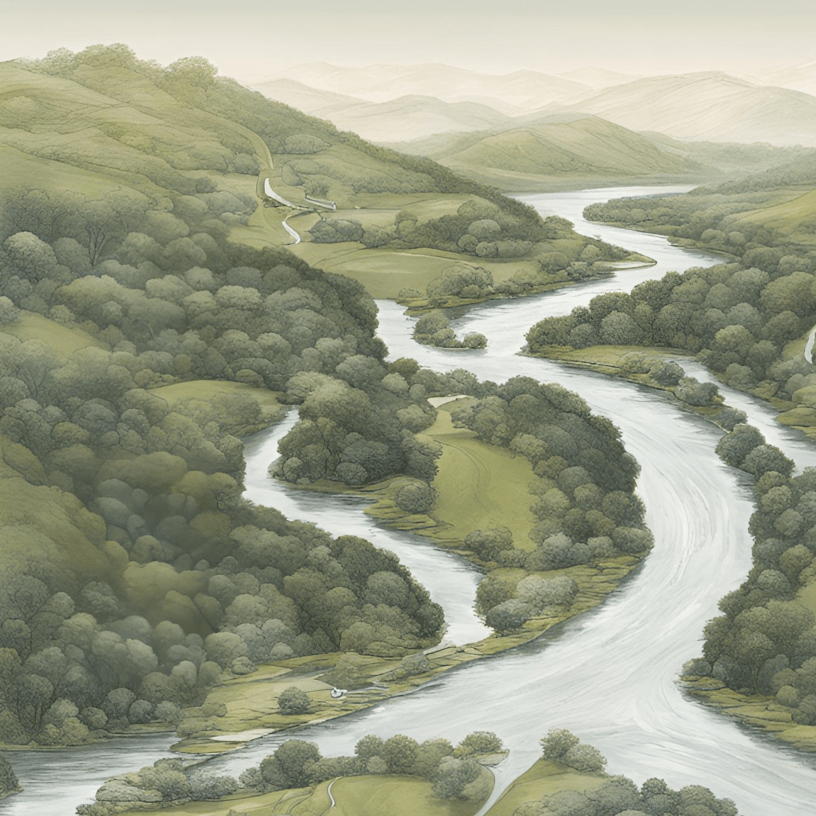
What exactly is a watershed. A watershed is an area of land where all rainfall drains to one single point. Watersheds are everywhere. Everyone on the planet lives within a watershed. Because of the way they define drainage they play a crucial role in collecting, storing, and distributing water. A watershed is a fundamental concept in understanding how water moves through our environment.

All the water falling within a watershed drains to a common outlet. This outlet could be a river, lake, or any body of water. Watersheds are defined by the slope of the land. High points, like hilltops and ridgelines, mark watershed boundaries. These boundaries determine how much water will move through the watershed and where it will end up.
Key Features of a Watershed
Headwaters: This is the origin of surface water flow, typically found in higher elevations such as mountains or hills where ground water seeps from the ground and forms a surface stream. However, they may also originate from cartesian wells where pressure forces ground water to the surface where it then begins to flow downhill. These small streams combine to form larger bodies of water.

Tributaries: Smaller streams or rivers that flow into a larger main river. As the watershed area increases, additional ground water is added to stream flow increasing the volume of water.
Main River/Stream: The primary watercourse that receives all surface and ground water from the watershed area.
Floodplains: Flat areas around rivers that can flood during periods of high water. These areas are vital for temporary water storage.
Outlet: The point where the watershed drains into a larger body of water like a river, lake, or ocean.
How Watersheds Work
When precipitation falls within a watershed, it follows one of several paths. It can:
Runoff: Water that flows over the surface of the ground and into streams and rivers.
Infiltrate: Water that soaks into the ground becomes ground water. This is what we call the water table, and it flows through the ground until it reaches a stream, pond, or river.
Evapotranspiration: Water is taken up by plants from the soil and released back into the atmosphere. This water, once in the atmosphere, may leave the watershed.
The movement of water through a watershed is influenced by various factors, including the slope of the land, soil type, vegetation, and human activities. For instance, steeper slopes result in faster runoff thus more streams, while flatter areas allow more water to soak into the ground contributing to more ground water and a higher water table.
Conclusion
Watershed hydrology is an essential concept for understanding how the landscape collects and channels water. Whether large or small, every watershed plays a vital role in the hydrological cycle.
 Moccasin Cove